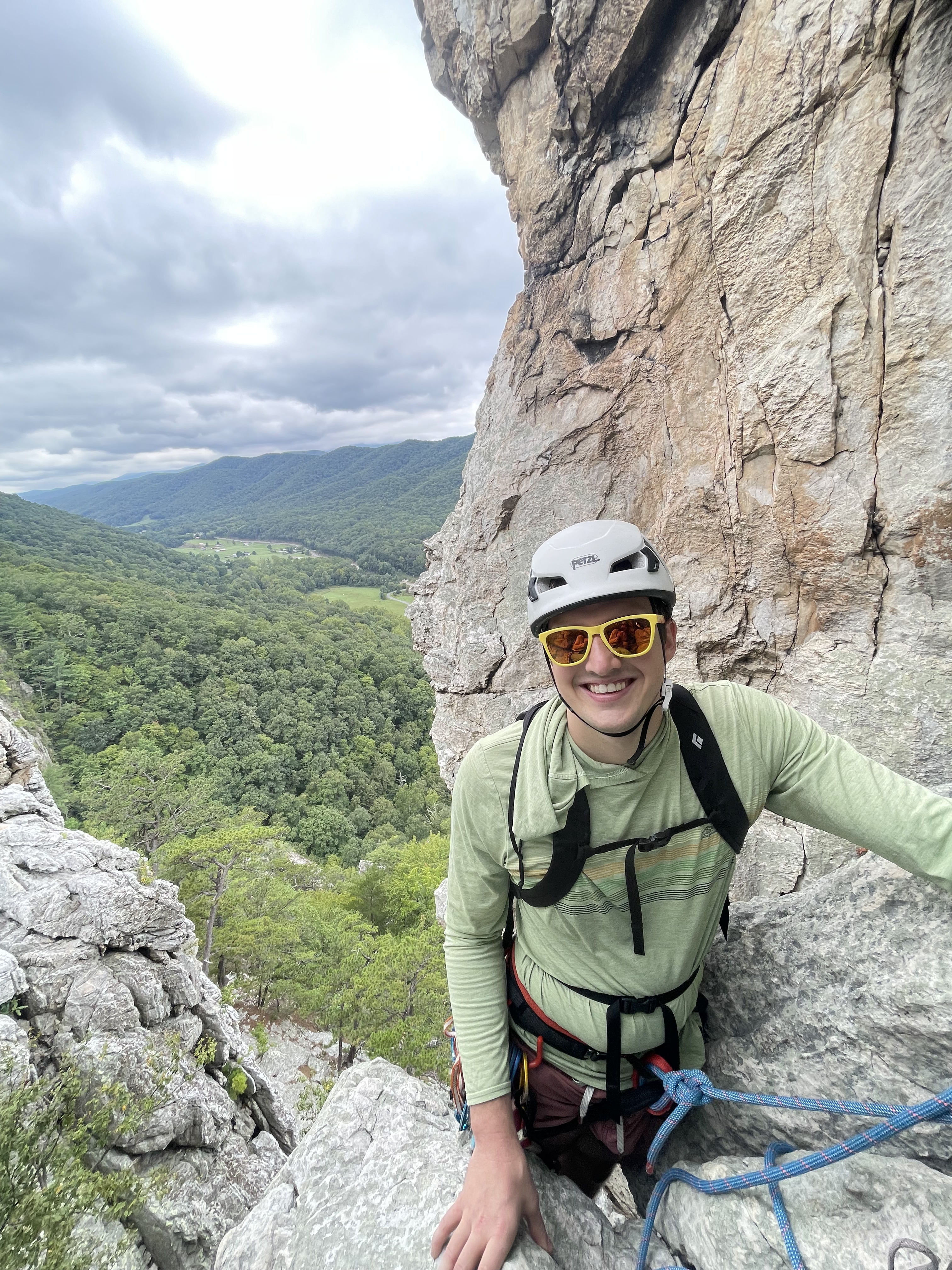
I climbed a new mountain with my wife today; Seneca Rocks in WV. She wanted a casual day, so we stuck to the “Old Ladies Route”, which is a 5.2 wrapping around the southern cliff of the mountain. While my day was great, I did encounter a group of climbers that really concerned me. That is why this is not a post about an idyllic day in the mountains with my wife. This is a post about safety in the mountains, the responsibilities of climbing leaders to their climbers, and the Duning-Kruger effect. In this post I want to talk about what I saw, my philosophies on climbing leadership, and why I feel strongly about safety in climbing.
The climb
Old Ladies is a 5.2. In casual terms, it is about as technical as a steep hike with some potentially fatal falls if you fell off. While technically a rock climb, 5.2 is a very easy grade. Pitch 1 (P1) involved hopping up a few boulders in the corner of a cliff. P2 was mostly just a walk across a ledge with 100 ft of exposure on one side. P3 is the only pitch with meaningful climbing, which involves ascending two short chimneys. At the top you are rewarded with a breathtaking view before rappelling 3 times to the ground. It is a good lap for a new leader who is with an experienced friend. It is a good excuse to hang outside while not pushing the grade. The only technical consideration is really in protecting your followers on P2 and on managing the rappels.
The main hitch in our day was that my wife and I got stuck behind a group of 4 climbers on our way up the mountain. I saw them from the ground, but I knew the belay ledge was quite large and that I would have plenty of space to build an anchor while I waited for them to clear out. When I got to the top of P1, I found 3 climbers sitting at the top with a 4th climber leading P2. I immediately knew that I was talking to inexperienced climbers because they didn’t know what a guide-mode ATC was or how to use it to belay. They did not have an anchor built, and instead had all clipped to webbing that was fixed to a rock for rappels. I had to build around their scattered ropes and belay up my wife. It took an hour after my wife arrived at the station until their leader finished P2, and another hour passed before the last of their group left the ledge.
P2 is a somewhat trivial climb, which my wife and I both finished in about 5 minutes. We again spent an hour waiting for the party ahead of us to clear the station. It took long enough that I back-climbed P2 and returned to the belay ledge as a means to kill time. We finally passed them at the summit, since one of their ropes was too short and they had to stop for an intermediate belay. It took about 2 hours for my wife and I to wait for our turn to rappel and finish the 3 rappels to the ground. When we finished at the bottom, we looked up to see that the group of 4 had not yet finished setting up the first of their 3 rappels.
While talking to a local guide on the descent, she informed us that she had a run-in with the same part of 4 the previous day and that they were stuck on the mountain until past midnight. This story was confirmed by a member of that climbing group. Besides the fact that they had personally cost me about 3 hours on the mountain while not letting us pass them, I was also personally concerned for their safety and the mindset that enabled them to get in so far over their heads.
My Philosophies on Climbing Safety
It would not surprise anyone who heard that I am a stickler for rules when it comes to climbing. I have personally seen mild climbing accidents and had two climbers at local crags die due to ground falls; both during descents from routes. I understood early on that I liked leading climbing trips but leading trips came with a lot of responsibility. This responsibility is very hard to understand at first due to the Dunning-Kruger effect.
We have all seen the Dunning-Kruger curve which depicts confidence vs. competence. When someone starts learning something, they do not yet fully understand all of the technical depth involved in the activity. As they gain some competence, they understand how little they know and their perception of their own ability plummets. It is only after significant study that confidence returns to the learner. In climbing, competence is equivalent to safety while confidence approximates your risk tolerance. This means that the point on this curve where competence is low and confidence is high is where injuries and deaths occur. New climbers who cannot correctly assess risk can put themselves and others in danger.
A demonstration of this effect in climbing happened when a student died at a local crag I use to guide at. I will not go into the specifics of the accident other than to say that it was her second day climbing outdoors ever and she died while cleaning the anchor from a top rope route. Anchor cleaning is likely the second-most dangerous activity we do in climbing (behind rappelling) because it involves many technical details and exclusively occurs at the top of a climb where the risk is greatest. It is not a skill appropriate for a climber on her second day out. Unfortunately something wrong occurred and the climber fell over 100 ft to the ground. Later discussion of the accident devolved quickly. Leaders of the climbing trip commented frequently on Mountain Project about how experienced they were, how there was nothing anyone could have done to prevent the accident, and how safe they thought route cleaning was. Meanwhile two local guides, both of whom I know personally, went on to give their technical analysis of the accident and what we can do in the future to prevent similar accidents from occurring. Aside from the specifics of the anchor cleaning process, their main suggestions were to not have inexperienced climbers clean routes and to hire knowledgeable guides to help improve group safety. This was a situation where two groups with the same confidence but different competencies were suggesting different actions in a life-or-death situation. It is not reasonable to expect everyone to be an expert, but it is important to highlight the impact that true competence can make in climbing risk assessment.
My own collection of experience, training, and near-misses has led me to adopt a similar view as the guides from the accident. Improving group outcomes is directly impacted by the composition of the climbing group and an accurate assessment of our own abilities. In the various climbing communities I have been a part of there are many climbers who say we should not concern ourselves with the risk-taking of others. They are the ones paying the price for their actions. If they die, it is their burden to bear. I feel that most people making these claims have never been in a serious climbing accident or had loved ones die while climbing. All accidents, even small ones, have ripples that extend far outside of their own group. The belief that your risk-taking does not affect others completely ignores the risk that rescuers would take to help save you, the trauma inflicted on others who see the accident, and the grief of family members left berhind when the worst occurs. Nothing in life is risk-free, but we owe it to others to engage with the activity responsibly.
Climbing and the Ego
I would normally not care about being stuck behind a large group on a 5.2 multipitch. Typically 5.2 is an ideal training ground for new leaders and followers to “cut their teeth”. When we saw how slowly the group was progressing, my wife and I actively discussed rappelling off of the climb to end our day early, as opposed to waiting in line. The responsibility for that decision lies more with us than the other climbing party. The concern I had was with the ability for the group to safely manage their own descent.
The group was composed of a single climber who was leading the route, and he demonstrated that 5.2 was already a difficult grade for him. The group as a whole had also demonstrated that they were relatively incompetent at descending technical mountain terrain. We can tell that this was not a one-off occurrence, as every guide we spoke to that day had something to say about this party of 4 on the mountain. In terrain requiring multiple rappels to return to safety, a group with a single leader, no competent followers, and poor descent skills was ascending the cliffs daily. That situation is a powder keg ready to ignite, and it demonstrates how ignorant the group was of their own incompetence.
I mention this because the group of 4 had already significantly impacted the experience of multiple parties on the mountain. If that group had an accident, it would have been the local rescuers, guides, or myself (if I were present and aware of the situation) who intervened to rescue the group. We would feel compelled to help. This builds the conflict where the group was the responsibility to us to properly assess their own ability, but that assessment requires them to be competent enough to make it. That is why we have an equal responsibility to help others understand their competence.
Addressing this competency gap is one of the most difficult conversations in climbing. Climbers often let their ego dominate their own assessment of their abilities. If an outsider questions a climber’s competence, it can feel like a personal assault of their ego. I have seen this reaction get magnified when it is a male climber questioning the competence of women or members of the LGBTQ community (which the group at Seneca was), as it can be a microcosm of the oppression they feel in other aspects of their life. I do not yet understand the best approach to having the conversations, but they are important to have none-the-less. I encourage anyone new to climbing to prioritize assessing their own ability, building competency, keeping their ego in check, and being open to conversations about the competency of themselves and others.